
 Image 1 of 1
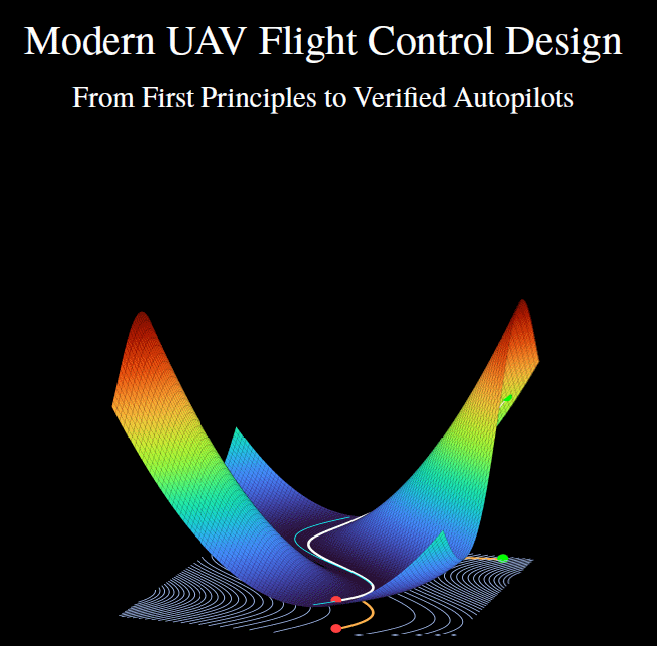
Modern UAV Flight Control Design - From First Principles to Verified Autopilots
Overview
Drawing on decades of aerospace, flight-control, navigation, and autonomous-systems experience, Dr. Paul Roysdon presents a comprehensive engineering treatment of modern UAV flight control, from the physical principles that govern an aircraft to the executable software and evidence needed to trust an implemented autopilot. Modern UAV Flight Control Design: From First Principles to Verified Autopilots begins with feedback, dynamics, coordinate frames, aerodynamics, propulsion, actuators, and six-degree-of-freedom simulation, then develops trim, linearization, classical and state-space control, successive-loop-closure autopilots, gain scheduling, robust and LPV methods, nonlinear control, command-filtered backstepping, adaptive control, model predictive control, and flight-envelope protection. Rather than treating control theory as an isolated mathematical exercise, the book continually connects equations to the physical aircraft, its sensors, actuators, computational timing, operating envelope, and real implementation constraints.
The treatment extends beyond the inner-loop autopilot to the complete autonomous flight-control architecture. Dedicated chapters address sensors and state estimation, waypoint and orbit following, path management and planning, camera-based guidance, formation flight, and coordinated autonomous motion. A major section on AI-assisted flight-control engineering explores automated analysis of flight-test dynamic response, learning aircraft models and trim conditions, learning PID and command-filtered-backstepping schedules, response-aware trajectory planning, adaptive test selection, supervised real-time learning, and autonomous mission execution. Throughout the book, three recurring engineering studies — a servo/gimbal, fixed-wing aircraft including powered-glider and jet cases, and a quadrotor — allow the same principles to be revisited at increasing levels of realism rather than presented as disconnected textbook examples.
What ultimately distinguishes this book is that the development does not stop at simulation. The final sections carry control algorithms from mathematical equations into sampled implementations and executable C, establish MATLAB-to-C numerical correspondence, develop golden-vector and regression testing, and show how requirements, nonlinear simulation, Monte Carlo testing, fault injection, timing analysis, hardware evidence, and flight-test evidence fit into a defensible verification process. Integrated capstone studies then bring the methodology together for a motor-driven gimbal, quadrotor trajectory controller, and scheduled fixed-wing autopilot. The goal is to give the reader more than a collection of control techniques: it is to teach the complete engineering process required to understand the chain from an autonomous command to the force and moment actually applied by the vehicle — and to determine what evidence is required to trust every link in that chain.
A free book chapter is available here.
Reviews
Peer-review in progress.
Notes
Designed for practicing aerospace engineers, graduate students, researchers, flight-control developers, and autonomous-systems engineers who want both the mathematical foundations and the implementation details of modern UAV control.
The book includes 39 chapters organized into nine parts, progressing from control fundamentals and UAV dynamics through advanced nonlinear and adaptive control, autonomous flight, AI-assisted flight-control engineering, executable software, verification, and integrated engineering studies. Five appendices provide notation, MATLAB studies, nonlinear-control and learning examples, C implementations, golden records, and autopilot dynamic-response analysis.
MATLAB examples deliberately keep the numerical design, control, propagation, and logging process visible so that readers can understand and modify the underlying mathematics rather than relying on opaque library calls.
The book distinguishes mathematical analysis, software verification, nonlinear simulation, hardware testing, and flight evidence rather than treating any one of them as a substitute for the others.
The original manuscript was unfriendly to colorblind readers; in particular red/green contrasts are troublesome. The new color palette uses orange/blue and red/blue contrast.
To minimize waste and environmental impact in the printing process, this book is printed in the 8.5” x 5.5” format.
To make this book extra special, it is printed with a premium full-color gloss hardcover, and premium 93 opacity 80lb pages with full-color figures.
Book Details
Publisher: Fibonacci Press
Language: English
Hardback: 617 pages
Chapters: 39
Parts: 9
Appendices: 5
Technical focus: Flight Control • Navigation • Guidance • Autonomous Systems • Flight Software • Verification
Companion code: MATLAB and C, with numerical/reference verification material
Dimensions: 5.5 x 8.5 x 3.5 inches
Published: anticipated 12/2026
Overview
Drawing on decades of aerospace, flight-control, navigation, and autonomous-systems experience, Dr. Paul Roysdon presents a comprehensive engineering treatment of modern UAV flight control, from the physical principles that govern an aircraft to the executable software and evidence needed to trust an implemented autopilot. Modern UAV Flight Control Design: From First Principles to Verified Autopilots begins with feedback, dynamics, coordinate frames, aerodynamics, propulsion, actuators, and six-degree-of-freedom simulation, then develops trim, linearization, classical and state-space control, successive-loop-closure autopilots, gain scheduling, robust and LPV methods, nonlinear control, command-filtered backstepping, adaptive control, model predictive control, and flight-envelope protection. Rather than treating control theory as an isolated mathematical exercise, the book continually connects equations to the physical aircraft, its sensors, actuators, computational timing, operating envelope, and real implementation constraints.
The treatment extends beyond the inner-loop autopilot to the complete autonomous flight-control architecture. Dedicated chapters address sensors and state estimation, waypoint and orbit following, path management and planning, camera-based guidance, formation flight, and coordinated autonomous motion. A major section on AI-assisted flight-control engineering explores automated analysis of flight-test dynamic response, learning aircraft models and trim conditions, learning PID and command-filtered-backstepping schedules, response-aware trajectory planning, adaptive test selection, supervised real-time learning, and autonomous mission execution. Throughout the book, three recurring engineering studies — a servo/gimbal, fixed-wing aircraft including powered-glider and jet cases, and a quadrotor — allow the same principles to be revisited at increasing levels of realism rather than presented as disconnected textbook examples.
What ultimately distinguishes this book is that the development does not stop at simulation. The final sections carry control algorithms from mathematical equations into sampled implementations and executable C, establish MATLAB-to-C numerical correspondence, develop golden-vector and regression testing, and show how requirements, nonlinear simulation, Monte Carlo testing, fault injection, timing analysis, hardware evidence, and flight-test evidence fit into a defensible verification process. Integrated capstone studies then bring the methodology together for a motor-driven gimbal, quadrotor trajectory controller, and scheduled fixed-wing autopilot. The goal is to give the reader more than a collection of control techniques: it is to teach the complete engineering process required to understand the chain from an autonomous command to the force and moment actually applied by the vehicle — and to determine what evidence is required to trust every link in that chain.
A free book chapter is available here.
Reviews
Peer-review in progress.
Notes
Designed for practicing aerospace engineers, graduate students, researchers, flight-control developers, and autonomous-systems engineers who want both the mathematical foundations and the implementation details of modern UAV control.
The book includes 39 chapters organized into nine parts, progressing from control fundamentals and UAV dynamics through advanced nonlinear and adaptive control, autonomous flight, AI-assisted flight-control engineering, executable software, verification, and integrated engineering studies. Five appendices provide notation, MATLAB studies, nonlinear-control and learning examples, C implementations, golden records, and autopilot dynamic-response analysis.
MATLAB examples deliberately keep the numerical design, control, propagation, and logging process visible so that readers can understand and modify the underlying mathematics rather than relying on opaque library calls.
The book distinguishes mathematical analysis, software verification, nonlinear simulation, hardware testing, and flight evidence rather than treating any one of them as a substitute for the others.
The original manuscript was unfriendly to colorblind readers; in particular red/green contrasts are troublesome. The new color palette uses orange/blue and red/blue contrast.
To minimize waste and environmental impact in the printing process, this book is printed in the 8.5” x 5.5” format.
To make this book extra special, it is printed with a premium full-color gloss hardcover, and premium 93 opacity 80lb pages with full-color figures.
Book Details
Publisher: Fibonacci Press
Language: English
Hardback: 617 pages
Chapters: 39
Parts: 9
Appendices: 5
Technical focus: Flight Control • Navigation • Guidance • Autonomous Systems • Flight Software • Verification
Companion code: MATLAB and C, with numerical/reference verification material
Dimensions: 5.5 x 8.5 x 3.5 inches
Published: anticipated 12/2026